A well known American author and businessman Lawrence Bossidy once remarked:
“I am convinced that nothing we do is more important than hiring and developing people. At the end of the day, you bet on people, not on strategies.”
The above quote brings about the critical role played by the human resources in any organisation. Indian Railways being the national transporter of the country and one of the biggest manpower employer in the world, the role of HR becomes even more important in this regard. HR role becomes critical also because Indian Railways has the responsibility of low cost mass transporter for the large scale masses in the country.
Brief history of HR:
Industrial revolution changed the history of world like never before. The means of production which were centred on small scale were now concentrated on big factories. This necessitated the need for process improvement and better human resource management. However the earlier focus was mainly on process improvement and standardisation which is seen in the works of Taylor, Fayol and other classical thinkers of management. It was only from the time of Elton Mayo that the focus starting shifting to better HR management. His theory of Human Relations was actually a precursor to the other theories of Motivation, leadership etc which actually build the foundations of Modern HR management. So from the time of classical era which treated human beings as RATIONAL ECONOMIC MAN, we have come to a stage where in the words of a famous HR experts “ HR plays the critical role in the success and failure of any organisation”.
Brief History of HR Management in Indian Railways:
One of the most fascinating Thing about Indian Railways is that it has a separate department and a separate group A organised service viz IRPS to manage the HR related work. However the same has evolved over a period of long time.
Till 1924, there was no separate organisation on the Railways to deal with the staff matters. Hence, Executive Officers had to deal with their own staff. However due to coming up of new lines and increased workload, the situation changed and many government managed railways introduced ‘Establishment Department’ after 1924. Early in 1946, the Railway Board decided that, on account of great increase in the volume and complexity of labour and establishment work on the Indian Railways, a distinct Railway Service should be established, with its own cadre, to be known as ‘Establishment Department’ of the ‘Superior Revenue Establishment’ of the State Railways. The recruitment for the same was to be done via Federal Public Service Commission. Mr. Ramaswamy Kannan of 1945 batch was the first officer to be recruited into the ‘Establishment department’.
The question of direct recruitment to Establishment cadre was re-examined in 1949 and the same was discontinued till the new service Named IRPS was established in 1975. The existing officers were given the option to be absorbed in other services.
Later on considering the increased workload Ministry of Railways decided to constitute a separate service named IRPS in 1975.. The recruitment for the same was to be done from UPSC. The first batch came out in 1981. The same arrangement has been going on till date. So at present the HR in IR is being managed by Personnel Department in consultation with respective departments.
Role of HR in enhancing productivity and efficiency:
Indian Railways is highly manpower intensive organisation with around 13.50 lakh employees. Its employees are spread over 17 zones, 68 Divisions, 6 Production Units, 16 Public Sector Undertakings, and organised into 358 categories and 20 levels. In this context the role of HR and HR management becomes critical in enhancing productivity.
Following are certain ways through HR enhances productivity and efficiency:
In words of Steve Wayne, “Human Resource isn’t a thing we do, it’s the thing that runs our business”. From this statement it is clear that HR is the key variable that decides the success or failure of any organisation.
- Taken in context of Indian railways HR is mainly responsible for safe train operations and timeliness of trains. Eg; the station masters, the loco pilots, guards etc are pivotal for safe train operations. Any drawback on part of HR can jeopardise the lives of many innocent individuals.
- In the times of great ICT revolution, coming up of AI, BIG DATA, HR remains the key variable for deciding the productivity of any organisation.
HR in Indian Railways at present:
Indian railways is a big organisation employing 13.28 lakh employees and around 13,000 officers. Indian Railways has made elaborate arrangements for various processes of HR for proper HR management.
Recruitment:
“You’re not just recruiting employees, but are sowing the seeds of your reputation.”
In this context Indian Railways has adopted a very comprehensive recruitment process.

Training:
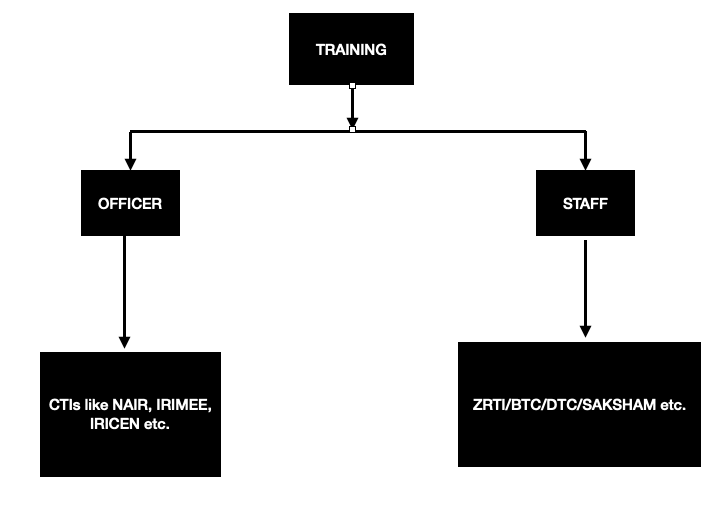
Indian Railways is a technology oriented organisation. It involves running of trains carrying thousand of human lives. Even a slightest mistake on part of the crew or guard or other running staff can be fatal for thousands of innocent human lives. This is the prime reason why Indian Railways has made elaborate arrangements for training of officers as well as staff.
Other aspects of HR management in Indian Railways:
Apart from elaborate arrangements for recruitment and training Indian Railways has established a whole department named Personnel Department which is involved in employees welfare. Indian Railways has a cadre of welfare inspectors and a junior scale post of APO Welfare in every division for ensuring employee welfare and organising summer camps, welfare initiatives like health check up, etc.
However despite having such an elaborate HR management structure Indian Railways still suffers from major issues in the field of HR. As per various reports Indian Railways is not being able to acquire the required talent in the changing times. Also the training structure and training content is old and it has outlived its utility.This is one of the prime reasons for falling operating ratio of Indian Railways. In this context following are some of the broad based suggestions that Indian Railways will have to adopt to make itself a good competitor vis a vis Road and Airlines sector.
Comprehensive HR Management In Indian Railways: Some Suggestions:
As it is widely recognised, there are 5 main roles in HR
- Talent management
- Compensation and benefits
- Training and development
- HR compliance
- Workplace safety
In the above context certain suggestions for better management of HR are summarised as under.
Recruitment: Need to adopt certain changes:
Recruitment being the entry point of anyone in the organisation, any change at this level will change the quality of human resource significantly. In December 2019 a decision to restructure the Railway Board and merge the cadre of 8 different services in Railways was taken. However there is no proper clarity on the details of that decision. The issues can be resolved at priority in the interest of all concerned so that the deficit of recruitment at the officers level can be sorted out.
Also for the staff recruitment Union Cabinet has decided to set up National Testing Agency which is likely to improve the quality of Human Resource joining the Railways.
In this context one more important thing to add is that due to large scale technological changes taking place and coming up of ICT on a large scale like TMS, IPAS, UMMID, HRMS Etc there is a need to evolve a cadre dedicated to the IT related tasks. This can help in better using the IT tools to enhance productivity of Indian Railways.
Training:
At present training is being imparted by various institutions like different CTIs for officers and ZRTI, BTC, DTC, PTC etc for staff which makes the entire training process very fractured and ad-hoc. In this context the context the concept of MDDTI for staff training has been mooted which when implemented will be game changer in training matters.
MDDTI:
MDDTI stands for multi disciplinary divisional training institutes. The concept was mooted by the transformation cell in railway board. The idea is to bring about the training in all the disciplines in railways under one roof. This will help In effectively mobilising the resources using economy of scale. This will also help in imparting multidisciplinary training among the staff which will help In multi-skilling. Another very important impact of this will be reduced departmentalism as training under a single roof will sensitise the staff toward the problems of other departments.
HRMS: A dawn of new era of HR management in IR:
HRMS stands for Human Resource Management System. This is a comprehensive software digitising all the routine HR related works like leave, settlement, e-pass, APAR etc among others. This is intended to sort out many of the present shortcomings in the HR management. Among many other things it is intended to bring about efficiency, accountability, and transparency in HR management.
HRMS In Action:
Till date 7 modules have been launched including e-Pass, APAR, Settlement, PF withdrawal, Post Retirement Complimentary Pass, Executive SR sheet. These modules have digitised to a large extent the working of HR. Earlier the turn around time for e-pass used to be around 6 to 12 hours which have now been reduced to less than 30 minutes. Also the earlier issue of pass being issued only from dedicated office has now been liberalised which has immensely helped the staff.
The PF withdrawal module has also helped fasten the PF withdrawal process as compared to the earlier module.
The most significant among the above modules is settlement module which is in the process of being operationalised. Once fully operationalised this will hugely reduce the time and effort in processing the settlement dues.
The other modules which are likely to be launches are leave record, selection etc which will completely digitise the personnel management work and this will help the executive in focussing upon broader task of Human Resource Management. This will also help in prioritising the welfare activity by the personnel department. Rail Pariwar Dekh Rekh Muhim by Personnel Department Central Railway is one such example.
Way forward: A new era for HR:
Debroy committee when recommending upon the HR reform in Indian Railways suggested that the reorganising the top/officer level HR is very important. In this context it suggested following schematic diagram for a future HR in Indian railways;

Also the committee suggested for the logical grouping of employees in following manner:
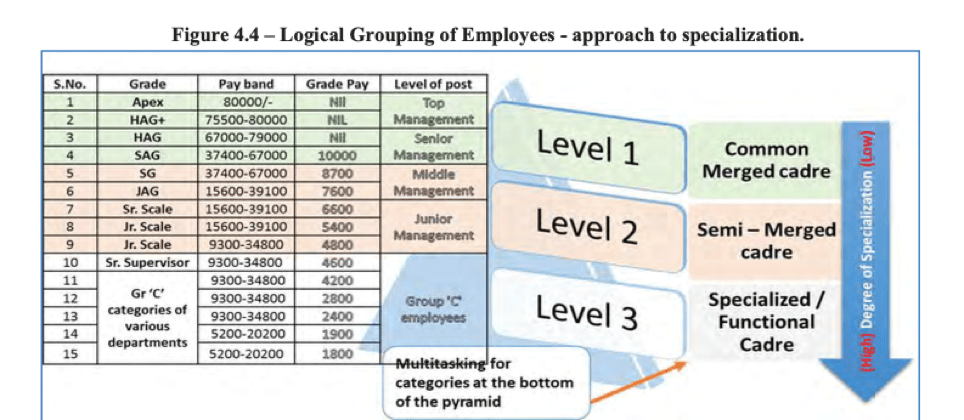
In the context of above railways should move towards a new era of HR which is SMART i.e. SIMPLE MORAL ACCOUNTABLE RESPONSIVE And TRANSPARENT. Only a SMART HR can enshrine Indian Railways in a new era of transportation.
 Wizards of Life!