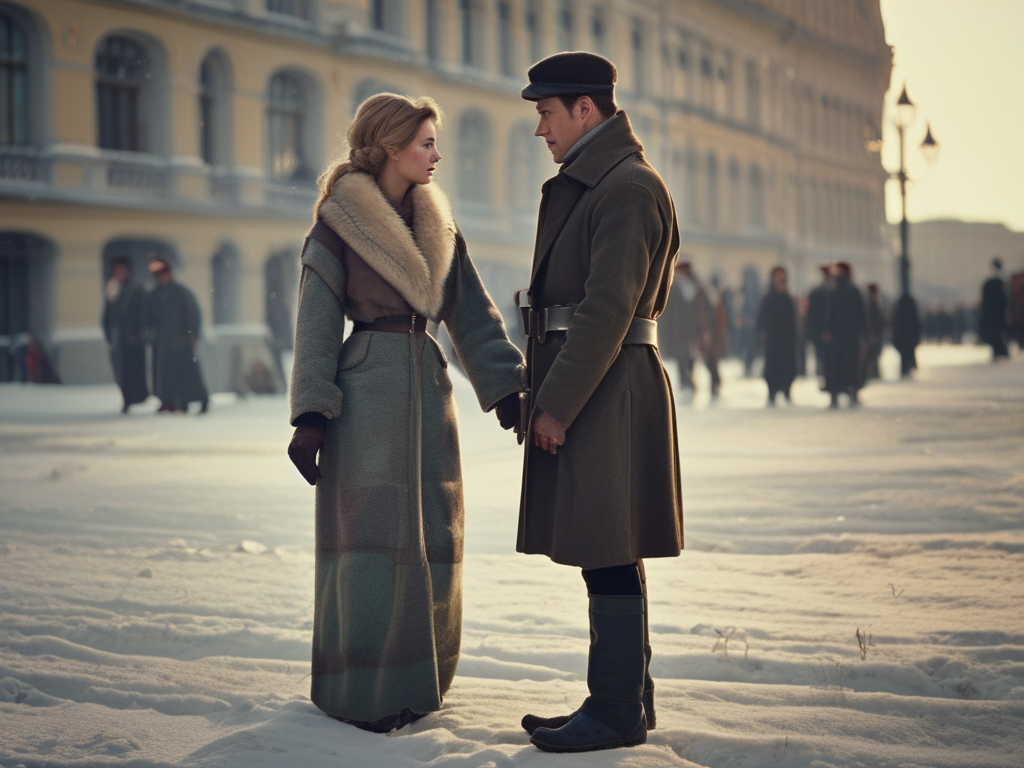
The finest of all the movies I have watched till date, Dr Zhivago is certainly a masterpiece created by David Lean. The movie can be put into historical drama category, however it is much more than that. It is a tale of love, loyalty, ideology and family values. The movie starts right before the First World War and goes till the Russian Revolution and the subsequent civil war. The duration of the movie is 3 hrs 17 minutes which is on the little higher side considering the current movies length.
The prime character in the movie is Yuri Zhivago who is a doctor by profession and a poet by heart. The entire story of the movie if told through the eyes of Yuri Zhivago.
Overview
“Doctor Zhivago,” directed by David Lean and based on Boris Pasternak’s Nobel Prize-winning novel, is an epic tale set against the backdrop of the Russian Revolution and World War I. The film is a sweeping romantic drama that follows the life of Yuri Zhivago (Omar Sharif), a poet and physician, as he navigates love, loss, and the tumultuous changes in Russian society.
Plot Summary
The story begins in pre-revolutionary Russia, where Yuri Zhivago, an orphan, is raised by a wealthy family. As a young man, Yuri becomes a doctor, marries Tonya (Geraldine Chaplin), the daughter of his adoptive family, and starts a family of his own. Despite his domestic life, Yuri is also a poet, and his creative spirit is central to his character.
During this period, Yuri encounters Lara (Julie Christie), a beautiful and strong-willed woman who becomes his muse. Lara is involved with the manipulative and powerful Komarovsky (Rod Steiger) but eventually marries Pasha (Tom Courtenay), a revolutionary. Yuri and Lara’s paths cross several times throughout the story, and they develop a deep, albeit tragic, love for each other.
As Russia descends into the chaos of revolution and civil war, Yuri is conscripted into the Red Army and separated from his family. After enduring the harsh realities of war and revolution, Yuri eventually reunites with Lara in the town of Yuriatin. They live together briefly in the countryside, away from the turmoil, but their happiness is short-lived.
The revolution and the rise of the Bolsheviks dramatically alter Russian society, and Yuri finds himself caught between his duty to his family and his love for Lara. Ultimately, Yuri is separated from both women by the relentless forces of history. Lara disappears, and Yuri is left to live out his days in relative obscurity, a shadow of the man he once was.
The film concludes with Yuri’s death years later, in a bleak, post-revolutionary Moscow. His half-brother, Yevgraf (Alec Guinness), narrates the story and reflects on the tragedy of Yuri’s life, recognizing him as a man who was swept away by the tides of history, yet remained true to his poetic soul.
Themes and Significance
“Doctor Zhivago” explores themes of love, loss, and the individual’s struggle against the overwhelming forces of history. It illustrates how personal passions and relationships are often at the mercy of larger societal changes, portraying the Russian Revolution not just as a political event but as a deeply personal tragedy for those caught in its wake. The film’s romantic and tragic elements, combined with its historical setting, make it a poignant and enduring cinematic classic.
Performances
Omar Sharif delivers a poignant performance as Yuri Zhivago, capturing the character’s quiet strength and deep sense of humanity. Sharif’s portrayal is subtle, relying on expressions and body language to convey Zhivago’s inner turmoil. His chemistry with Julie Christie, who plays Lara, is one of the film’s highlights. Christie embodies Lara with a mix of vulnerability and resilience, making her a memorable and complex character.
Geraldine Chaplin is also notable as Tonya, Zhivago’s devoted wife. Her performance is understated yet powerful, providing a strong counterpoint to the passionate affair between Zhivago and Lara. Rod Steiger as the manipulative Komarovsky and Alec Guinness as Zhivago’s half-brother, Yevgraf, add depth to the film’s portrayal of the political and social forces at play.
Themes and Interpretation
“Doctor Zhivago” is not just a love story; it’s also a meditation on the impact of historical events on individual lives. The film explores themes of love, loss, and the clash between personal desires and societal expectations. It also delves into the nature of revolution, examining how the promise of change can often lead to unforeseen consequences and suffering.
The film’s pacing is deliberate, allowing the audience to immerse themselves in the characters’ lives and the historical context. However, some may find the film’s length (over three hours) challenging, as it requires patience and a willingness to engage with its slow-burning narrative.
Conclusion
“Doctor Zhivago” remains a towering achievement in cinema, combining grand historical sweep with intimate, personal drama. It is a film that transports viewers to a different time and place, immersing them in the beauty and tragedy of its story. Despite some criticisms, the film’s emotional depth, stunning visuals, and memorable performances make it a must-see for fans of classic cinema and epic storytelling.
If you appreciate films that offer a blend of history, romance, and breathtaking cinematography, “Doctor Zhivago” is a cinematic experience that should not be missed.