
Tag: IKIGAI

  • Finding flow in What we do!

    Finding flow in What we do!

    While I was reading the book IKIGAI written by Hector Gracia and Francesc Mirallles one of the prominent theme in the book was “Finding flow in Everything that we do”. When I read about it I found it to be an interesting concept. This concept can greatly help you in finding your IKIGAI and it can certainly help in living a more meaningful life. So let’s explore the concept in details:

    Finding flow in everything you do means engaging so deeply in an activity that you lose track of time, feel energized, and are fully present. The concept of flow was introduced by psychologist Mihaly Csikszentmihalyi, and it’s closely tied to fulfilment, creativity, and high performance.


    What is Flow?

    “Flow is the state in which people are so involved in an activity that nothing else seems to matter.” — Mihaly Csikszentmihalyi

    This means anyone who is in the state of flow is fully engrossed in whatever he is doing. I am reminded of the story of Arjun when he was asked to shoot the bird eye. He was so focussed on the bird’s eye that nothing else seemed to be visible to him.


    🔑 Key Characteristics of Flow

    1. Complete concentration on the task
    2. Clarity of goals and immediate feedback
    3. A balance between challenge and skill
    4. A sense of control over the activity
    5. Loss of self-consciousness
    6. Distorted sense of time (time flies)
    7. The activity feels intrinsically rewarding

    🛠️ How to Find Flow in Daily Life

    1. Choose Meaningful Activities

    • Engage in things that align with your values or spark curiosity.
    • Even mundane tasks can feel meaningful if tied to a purpose.

    2. Set Clear Goals

    • Know what you’re trying to achieve in each session.
    • Break big tasks into small, actionable steps.

    3. Match Challenge with Skill

    • When the task is too easy it will lead to boredom and you will leave the task eventually.
    • When the task is too hard it will lead to anxiety and you will not be able to hold on to the task for long.
    • When the task is just above your comfort level i.e. the task is Just right you will achieve the flow.
      So you need to adjust the task or your skill level as needed.

    4. Eliminate Distractions

    • Turn off notifications, set boundaries, and create a dedicated space.
    • Use techniques like the Pomodoro method or deep work blocks.

    5. Focus on the Process, Not the Outcome

    • Flow comes from being immersed in the doing, not obsessing about results.

    6. Practice Regularly

    • The more you experience flow, the easier it becomes to return to that state.

    🧘‍♂️ Flow and Mindfulness

    Flow shares similarities with mindfulness, but:

    • Mindfulness = open awareness of the present
    • Flow = intense focus on a specific task

    Both reinforce each other and enhance well-being.

    Examples of Flow Activities

    • Writing, painting, coding, gardening
    • Playing sports or instruments
    • Solving puzzles or doing crafts
    • Even cleaning or organizing (with the right mindset)

    Above is the loose description of Finding your flow. When I read about this concept I found it to be really fascinating and worth reading about.
  • ‘IKIGAI’- Japanese Secret to ‘Long and Happy Life’

    ‘IKIGAI’- Japanese Secret to ‘Long and Happy Life’

    Ikigai is perhaps one of the most read and talked about self help book worldwide. The book written by Hector Gracia and Francesc Miralles is about the idea of IKIGAI- A Japanese concept which is translated as ” The Happiness of always being busy”. The book explores the concept of IKIGAI in detail and the writers offer some empirical ideas regarding the secrets of long and healthy life. The writers also interviewed the residents of Ogimi in Okinawa province of Japan where majority of the ‘supercentenarians’ are living. The word supercentenarians stands for people living above the age of 100. The book explores their customs, diet, rituals and lifestyle to find secrets to long and healthy living. However before going into the detailed review lets first understand the concept of IKIGAI.

    IKIGAI

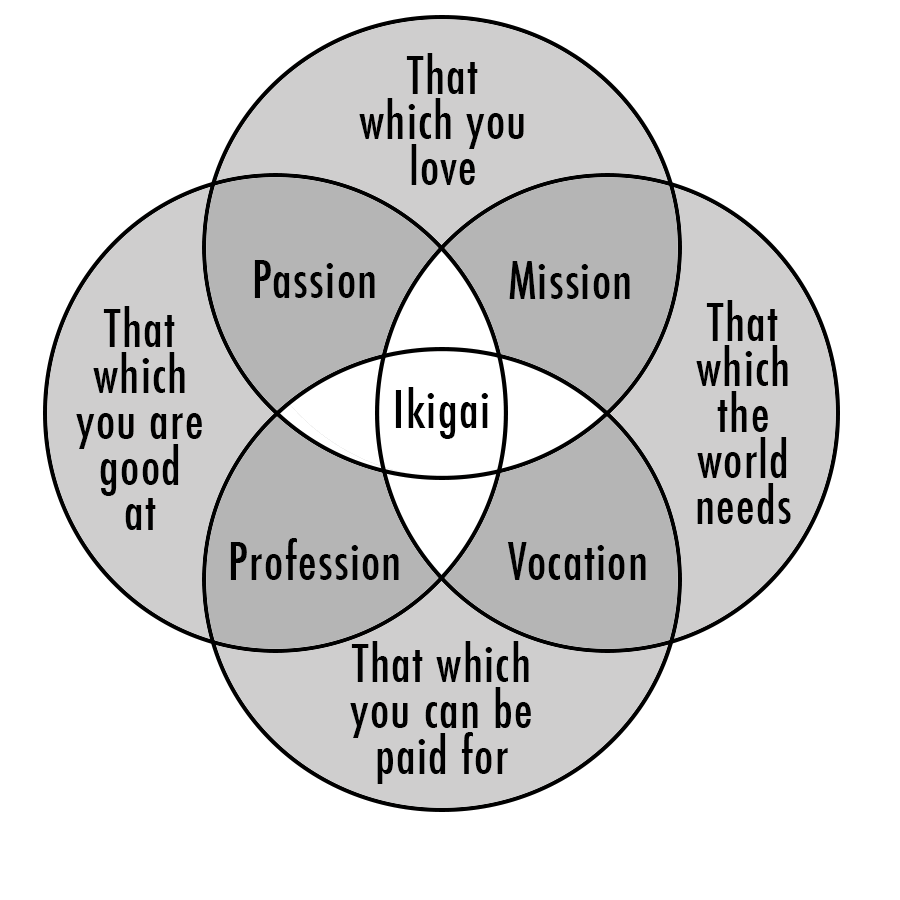
    Ikigai (生き甲斐) is a Japanese concept that means “a reason for being” or “a reason to wake up in the morning.” It represents the intersection of what you:

    • Love (your passion)
    • Are good at (your vocation)
    • Can be paid for (your profession)
    • What the world needs (your mission)

    The word comes from:

    • “iki” (生き) meaning “life”
    • “gai” (甲斐) meaning “worth” or “value”

    Together, ikigai refers to the thing that gives your life purpose, fulfilment, and satisfaction. It’s often visualized as a Venn diagram showing these four overlapping elements.

    Ikigai Misunderstood and the Origin of the Ikigai Venn Diagram

    The above Venn Diagram makes it very clear that IKIGAI of a person is the very core of his being in this world, something for which he wakes up every morning. However the difficult part is to find the IKIGAI. IKIGAI varies from person to person and every person needs to find their IKIGAI in order to live a long and meaningful life. The book is largely about the people who are practicing IKIGAI and those who have found their IKIGAI. However in my opinion the book lacks its proper emphasis on How to find your IKIGAI.

    The book is divided into 9 different chapters each having emphasis on one or the other thing pertaining to long and healthy life. The book talks about the idea of IKIGAI which is largely practiced in Okinawa province of Japan. There are many good concepts proposed in the book.

    1. If you have an active mind your body will remain youthful.
    2. The book make us aware of the concept of Logotherapy- A psychotherapy developed by Viktor Frankl, an Austrian neurologist, psychiatrist, and Holocaust survivor. The core idea of logotherapy is ‘The primary human drive is not pleasure (Freud) or power (Adler), but the pursuit of meaning’.
    3. Morita Therapy- Morita Therapy is a Japanese form of psychotherapy developed by Dr. Shoma Morita in the early 20th century. Unlike Western therapies that focus on changing or analyzing emotions, Morita Therapy teaches acceptance of emotions and emphasizes action in alignment with purpose.
    4. The book largely emphasises upon finding flow in life. Flow in life as per the writer means one should be engrossed in the task that they are doing.
    5. The book has many interviews of the people living over the age of 100 years and it tries to explore the reasons for their long and healthy living.

    Despite all these concepts the book seems to lack the conceptual depth. The book just explores the concept of IKIGAI but doesn’t suggest any specific method the find your IKIGAI. The interviews are also not very informative in nature. The first 7 chapters are a good read but the 8th and 9th chapter seem out of focus. The explanation of Yoga postures through description seems unnecessary. The book also describes the concept of Chinese martial art known as Tai Chi but explanation of this through words seem unnecessary as these are practices and not describable properly through words. The most strange thing that I saw in the book was about a financial advice that it offers in the last.

    Who Should and Should not read this Book

    The book is a good read if you are a beginner in the area of Self Help Books. The book is lucid and easy read. Its a short book and can be easily completed in around 4-5 hours. However the book is not recommended for those who have read quite a few books on this genre.

    I completed the book in a day and except the last 2 chapters I personally enjoyed reading the book. In my opinion the book deserves a 3.5 star.