Tag: adventure

  • A Transforming Trek to Deorital-Chandrashila

    A Transforming Trek to Deorital-Chandrashila

    Regular Office work can lead to a boredom in long run. It was a sunny winter day when I was having a discussion with one of the office colleagues to do something different as we were feeling bored due to the repetitive nature of the work in a government system. It was at this point that a thought came up to do a High Altitude trek in the Himalayas. The major reason for selecting this option was to see the ice covered mountains for the first time in our lifetime. Having decided to do a trek in Himalayas the search for the suitable trek begun. At first we decided to do a winter trek but the harsh winter in the Himalayas scared us and we decide to do a spring trek instead. Since spring is the rhododendron blooming season we started searching for a trek which has the maximum bloom of rhododendrons. The search ended at the not so famous but extremely beautiful trek known as Deorital-Chandrashila trek.

    Deorital-Chandrashila trek is a trek which is mostly known for the blooming Rhododendrons and the sighting of beautiful birds. It is also known for Tungnath Temple which is one of the five Kedars in the Himalayas. The trek is a four day Journey into the beautiful landscapes of Kedarnath Bird sanctuary and ends with the summit climb of Chandrashila peak at the final day.

    The Journey to Base Village

    Sari is the base village to the Deorital Trek. Sari is a beautiful ancient village nestled in the lap of Himalayas at around 6000 feet. The Village is located at a distance of around 240 KM from Dehradun. Since my wife was also going for the trek with me, we took a taxi to drive us to Sari Village. The drive was scenic and we stopped at the famous Devprayag-the meeting point of Alaknanda and Bhagirathi rivers. It took us around 8 hrs to reach the base village.

    Confluence of Alaknanda and Bhagirathi
    Getting Settled up at Base Village

    I had booked the trek through IndiaHikes. The hiking agency has a camp office at Sari Village. We reached the base camp at Sari at around 5:00 PM and got settled up in the tents at the IndiaHikes campus. Once we came out of our tents for the evening tea our guide showed us the first glimpse of the Chandrashila Peak. While looking at the peak it looked both beautiful and Challenging. In fact Deorital-Chandrashila is one of the few treks where the peak is visible from the base camp itself.

    View of Chandrashila peak from Sari Village

    One Good thing about the IndiaHikes is that they have a detailed plan laid out for all of their treks. The Trek leader and the support staff are well trained and supportive of any of the needs. This makes the trekking experience very pleasant and memorable.

    Day-1: Sari Village to Deoriatal Lake

    As the famous saying goes- Journey of a thousand miles begins with a single step. We started the 35 km long trek from the Sari village to reach Chandrashila peak four days later. The journey of the next four days was going to be transforming and memorable. The trek starts with steep ascent for the first 1 hour with many of the houses in the vicinity. However After about and hour the slope becomes gentle and easy on the legs. When we started our journey from the base village few of us were really beginning to think that they were not going to make it to the peak. But when you start doing any such thing you really get to know your body capabilities. After about 1 hr out bodies were quiet comfortable with the hike and we all has achieved our natural pace.

    The first campsite of this trek is truly a memorable experience. The campsite is located in the vicinity of the Deoraital Lake. This lake is popularly famous in Indian mythology because this is the place where the Yaksha Prashna episode unfolded between Yudhishthira and Yaksha (a divine nature spirit). Naturally also this alpine lake is famous for its mirror-like reflections of the Chaukhamba massif and its calm, meditative atmosphere.

    During the winter this lake gets frozen and the entire area gets covered by snow which adds to the experience of the trekker. However the most beautiful part of this place is the magical evening alongside bonfire and birdwatching. During my camping at this place I could spot many birds. If you are a bird watcher then this is the trek to do in Himalayas. The bird activity is especially high during the morning and in the month of spring.

    Day-2 Deoriatal to Syalmi via Rohini Bugyal

    This is the first long day of the trek with roughly 9 Kms to cover. We started the trek early in the morning to reach Rohini Bugyal during the lunch hour. This day is exclusively for the rhododendron lovers. The rhododendrons are found all over the trek on this day with their colours changing with the change in altitude. When you start early in the morning you can spot plenty of birds perched on the tree top sunbathing. This entire day you are trekking in Kedarnath Wildlife sanctuary and if you are lucky you can spot some wildlife too. We were lucky that we were able to spot a Himalayan Jackal just ahead of the Rohini Bugyal although I could not film it. The major highlight of this day was the rhododendrons and the lunch at the Rohini Bugyal.

    In the above pictures look for the fading colours of the rhododendrons as the height increases. This was my first encounter with these trees and it was just an amazing experience.

    Having Lunch overlooking the majestic mountains was an all together a different experience.

    The sunset at the Shyalmi campsite was just amazing. Watching sunset high up in the mountains far away from the civilisation is just a different experience all together.

    However my most unique experience of the day was the Shepherd houses. I was seeing them for the first time. These houses are simple lacking any kind of amenities. Shepherds live here when they come to stay here during the dummers. If you are lucky and the sky in cloud less you can do stargazing in the night. This campsite is an excellent place for stargazing. However we were little unlucky, it was cloudy that day.

    Day-3 Syalmi to Baniyakund

    The distance of this day is approximately 6.5 km and it takes 4 to 5 hour to cover this distance by walk. This day is fully dedicated to forest walk and feeling the nature around us. The day is not very difficult neither it is very easy. We started our trek at 9 AM in the morning to reach the Baniya-Kund Campsite around 3 PM. The forest section on this day is thick and majestic. If you are trekking peacefully you can hear the sound of the forest. We could hear the sound of many of the birds during the morning time of our trek.

    A beautiful experience of this day is that you trek along the river stream. The sound of water is with you throughout the day of your trek which is a different experience all together. The Baniyakund campsite is located at location which is quite touristy. If you are a snow lover it quite definite that you will find snow at this campsite even in March and April as well.

    Day-4 Summit Day

    This was the longest, hardest and most rewarding day of the trek. The summit push starts at 3 am in the morning. However in my opinion it starts way before that in your mind. The summit of Deorital Trek is one of the most beautiful summit. You get to see 360 degree view of the Himalayan peaks from the Chandrashila peak which itself is a 4200 meter peak. At the start of the this day trek we started from the campsite to reach the starting point of Tungnath Temple trek at about 5 am. From here the actual trek starts. If you trekking in winter and spring you will encounter huge snow in this area. The snowcapped meadows are one of the most beautiful landscape which you will encounter on this trek.

    Since I started early in the morning the view of sunrise from this meadow was a mesmerizing experience. The sunrise looks so good that it takes away all the discomfort of waking up at 3 am in the morning.

    This day holds another treasure for wildlife lovers. The colourful state bird of Uttarakhand Monal is especially found in this area. I was lucky enough to spot a pair of Monal on this route in the morning although I could not film it.

    Darshan of Tungnath, the highest Shiva temple in the world was a divine experience. Although the temple was closed and filled with snow we did the Darshan from outside. This temple is one of the Panch Kedars and thousands of devotees visit this temple every year.

    The Chandrashila Peak is located at a distance of 1 km from Tungnath and it takes around 1 hrs to reach the Chandrashila peak from Tungnath.

    During my trek due to turn around time I could not reach the Chandrashila peak however everyone who reached the peak was mesmerized by the beauty of the Himalayas.

    The concept of trekking in modern terms is new in India. However during the ancient period this was very much prevalent in our country. Monks used to go in the Jungles to do ‘Tapasya’.

    Deoriatal was my first multi day trek and it was really memorable. The harsh conditions of the mountains made me appreciate whatever I have in my life and the much needed disconnect from the modern world gave me some time to think about myself. Overall it was truly a transforming experience.

  • A Quiet Stay at Kathi(Satara)

    A Quiet Stay at Kathi(Satara)

    There are places that don’t ask anything from you.
    They don’t demand productivity, urgency, or performance.
    Kathi is one such village.

    Tucked quietly in the folds of the Sahyadris in Satara district, Kathi does not announce itself. There are no landmarks shouting for attention, no itineraries to tick off. What it offers instead is far rarer — a life that unfolds without hurry.

    Indian Cities are increasingly becoming congested and overcrowded. Finding a peaceful moment in the cities is becoming a luxury now. Pune City has been particularly heavily polluted this year with AQI reaching to 400. It was in this frame of mind that I decided to take some time out and stay at a quiet place outside the city. My search ended at a Quiet Villa named as Red Stone Villa by Koyna stays located in a small village named Kathi in Satara district of Maharashtra. Most of the population in this village is involved in agriculture. However with the coming up of tourism a small population is now being involved in hospitality and the land use and occupation change is now visible here.

    When I reached this Kathi village I was amazed with the rustic beauty and old world charm of this village. The village lies at a hill plateau overlooking the Shivsagar Dam built on Koyna River. The natural setting of the place is amazing.

    The Village is still far away from what we call ‘Development’ in modern terms. There are no modern cafes and restaurants. People are simple and welcoming. This makes this place perfect for Eco-tourism and many eco tourism resorts are now opening in this village. This village is perfect place for spending quiet days. During my stay at this place I was reminded of the the Dak-Bunglows of British times. Britishers used to built Dak-Bunglow at places which were far from modern world and having plenty of nature around. This gave them the time to think and innovate.

    Relaxing Activities In Kathi

    The village of Kathi is located at a place which is called Oxygen valley. This is because of strong winds that blow here throughout the day. The wind is so strong here that the largest Windmill farm in Asia is located near this village. You can just sit and feel the air in your lungs.

    Wind Mill farm

    Visit to the nearest Windmill farm is a great experience here. The road from Kathi to Satara passes through this wind mill farm and there is one spot where the road is straight over the plateau. This is a perfect place to take an evening walk. I took a walk on this road one evening and it felt magical.

    K-2 Point

    When it comes to viewing sunset in the Western Ghats I found that K-2 point offers one of the most mesmerising view. The place is located at the highest point in the region overlooking the Koyna Backwaters. The view of the sunset from here is just amazing. The only catch is that due to excessive fog at times it becomes difficult to view the sunset. What I found most beautiful is that this place has no crowd at all and hence you can enjoy the beautiful sunset in peace. However despite its natural beauty what disturbed me here was that people have thrown beer bottles and water bottles which was acting as a thorn in the beauty of this place. Seeing this one can sense how much civic sense Indians lack.

    Dhareshwar Shiv Mandir

    Perhaps one of the most unique temples in India that I have visited this Shiva temple is nestled into deep forest and on the edge of a mountain overlooking a huge valley. The main shrine is in a rock-cut cave traditionally associated with Shri Ram’s era, housing a temple to Shri Ram along with a sacred Shiva shrine (Shivshambu Mahadev) regarded as a teerthakshetra. This place is a great nature spot and there is an all weather active waterfall here. When I visited this temple I found that to be crowd free and full of peace and tranquility. This place is great for meditation and Dhyan and one can sit for some time here to connect with spirituality. The active waterfall of this place is considered sacred and the locals use the water for different religious purposes.

    This place is a heaven for star gazers as this place still has not been heavily polluted by light pollution. During the night time star gazing is a great activity here. During our visit we sat in the night sky and all the night stars were visible to us. Using the apps like night sky enhances the experience of Star Gazing by displaying the positions of the stars in the sky.

    Kathi Village has everything that a slow life asks for. A lakeside location, spiritual places nearby and a great sunset view point to go and sit during the evening. Places like these are a modern day luxury for us when the “modernisation and cafe culture” is reaching in every nooks and corners of the country. The very nature of the modern lifestyle is stress-full and few days spent at places like these adds much needed value to our quality of life.

  • Ellora Caves( एलोरा की गुफाएं): They Amaze You Every Time You Visit!

    Ellora Caves( एलोरा की गुफाएं): They Amaze You Every Time You Visit!

    We all have grown studying about Ajanta and Ellora caves and their beauty. However if someone has prepared for UPSC for sometime it becomes even more a thing of curiosity because these caves are a thing of great cultural importance not only for India but for the entire world. These caves are a living example of what indian culture has been in the past.

    My first experience of visiting the Ellora caves was in 2019 when I visited these caves with two of my friends. I visited Ellora Caves again in January 2023 and I must say both the times it was a magical experience. Standing in front of Kailash temple one gets lost in its grandeur and beauty.

    History of Ellora Caves

    The history of these caves dates back from 600 AD to 1000 AD. There are around 100 caves at the site out of which 34 are open to public. These caves belong to all three religions prevalent in the region at that time viz. Hinduism, Buddhism and Jainism.

    Counting wise Cave No 1 to 12 belong to Buddhism. Cave No 13 to 29 belong to Hinduism and Cave No 30 to 34 belong to Jainism. Although the entire complex of Ellora caves is a treasure to behold, the two most significant of them viz Cave no 10 called Vishwakarma cave and cave no 16 known as Kailash temple is discussed below.

    Cave No 10 (Vishwakarma Cave)

    Built in early 7th century this is the only Chaitya(Prayer Hall) in the series of Ellora Caves. Vishwakarma Caves are also known as ‘Sutur Ki Jhopdi’ in the local language. At the apsidal end of the chaitya hall is a stupa on the face of which a colossal high Buddha is seated in ‘Vyakhyana Mudra(teaching posture)’. A large Bodhi tree is carved at his back. Many of the Buddhist devotees come and prey in this caves daily even today. The cave is known as “Carpenter’s Cave”, because the rock has been given a finish that has the appearance of wooden beams.

    Entrance of Vishwakarma Cave( Carpenter’s Cave)
    Buddha in Vyakhyana Mudra in Carpenter’s Cave

    Cave No 16( Kailashnath Temple)

    Brief description of Cave no 16

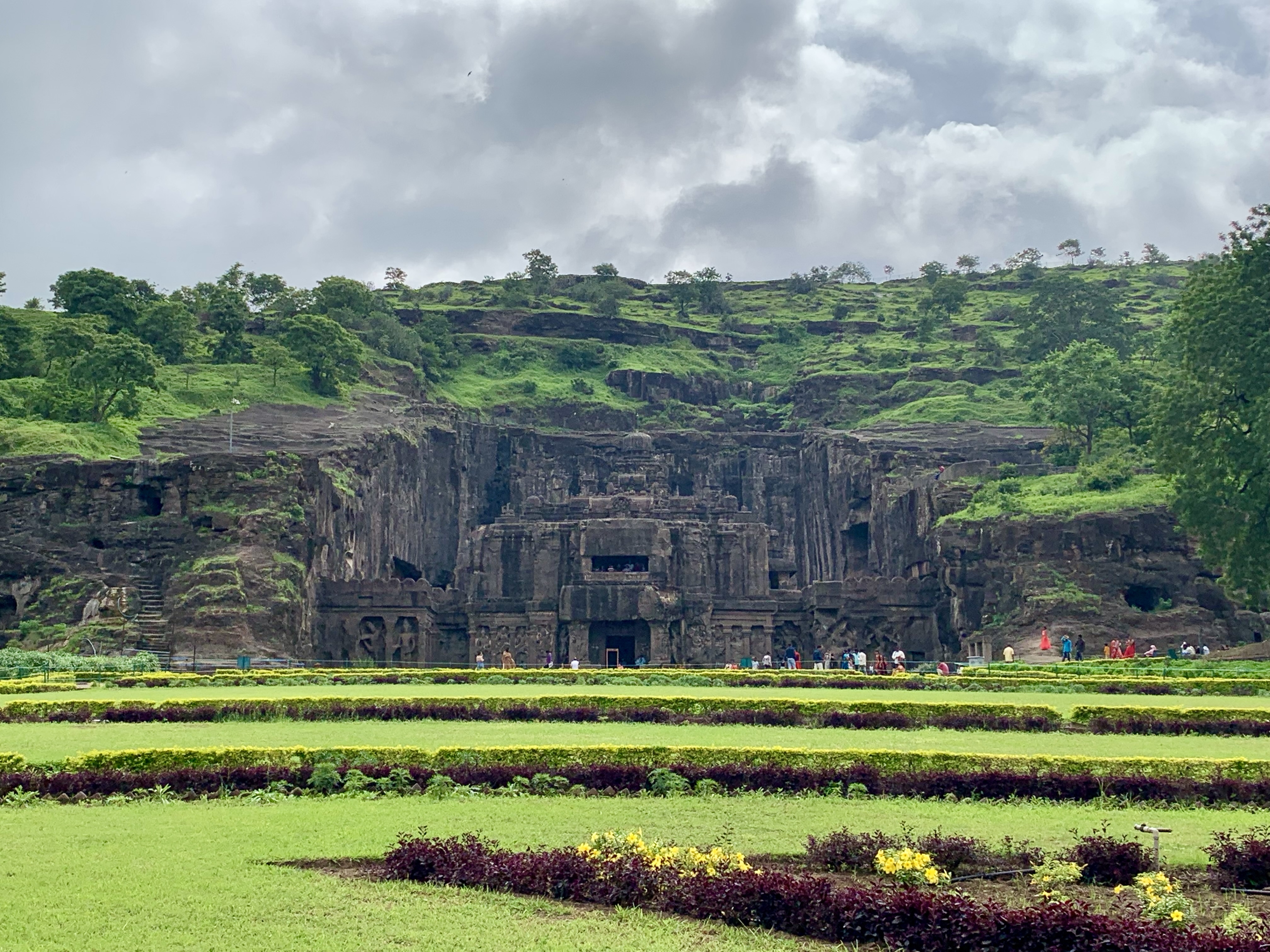
    Cave No 16 of Ellora Caves is also known as Kailasa(Kailashnath) Temple. The temple dedicated to Shiva is world famous for being the largest megalithic structure carved from the cliff face of a mountain. it is considered one of the most remarkable cave temples in the world because of its size, architecture, and sculptural treatment. It has been called as “the climax of the rock-cut phase of Indian Architecture”. According to the historical evidences the Kailasa temple was commissioned by Rashtrakuta Rulers during the 7th century AD. The temple looks very grand from the entrance itself and in my opinion it is the most beautiful structures in the entire cave architecture of India.

    View Of Kailasa Temple from the Entry Gate of Ellora
    Front View of Kailasa Temple from the Inside
    Side View of Kailasa Temple from the Inside

    How to Reach Ellora Caves?

    Aurangabad is the nearest city to Ellora Caves. The city is connected by both rail and road transport from all the major cities in India. There are ample of good hotels available in the city to stay. However I will that one should stay in the resorts nearby to the Ellora Caves. During the monsoon the area becomes very beautiful and there are very good views of the ancient city of Daulatabad. The best time to visit the Ellora Caves is during the monsoon or during the winter season. The area becomes quite hot during the summer time hence wondering around all the caves becomes exhausting during the summer time.

    Ellora Caves are one of the most astonishing rock cut structures in the world. They are India’s contribution to the entire humanity and they showcase the technological sophistication and the advancement of ancient India. Being the citizen of India it is recommended that everyone must visit them to appreciate the advancement of science, technology and spirituality in ancient India.